

Introduction
The violin is one of the most celebrated musical instruments in history, known for its expressive sound and versatility. It has been a cornerstone of classical music, folk traditions, and even modern genres. But where did the violin come from, and how did it evolve into the instrument we know today? This article explores the history of the violin, its construction, and the emergence of related string instruments like the cello and double bass.
Origins of the Violin
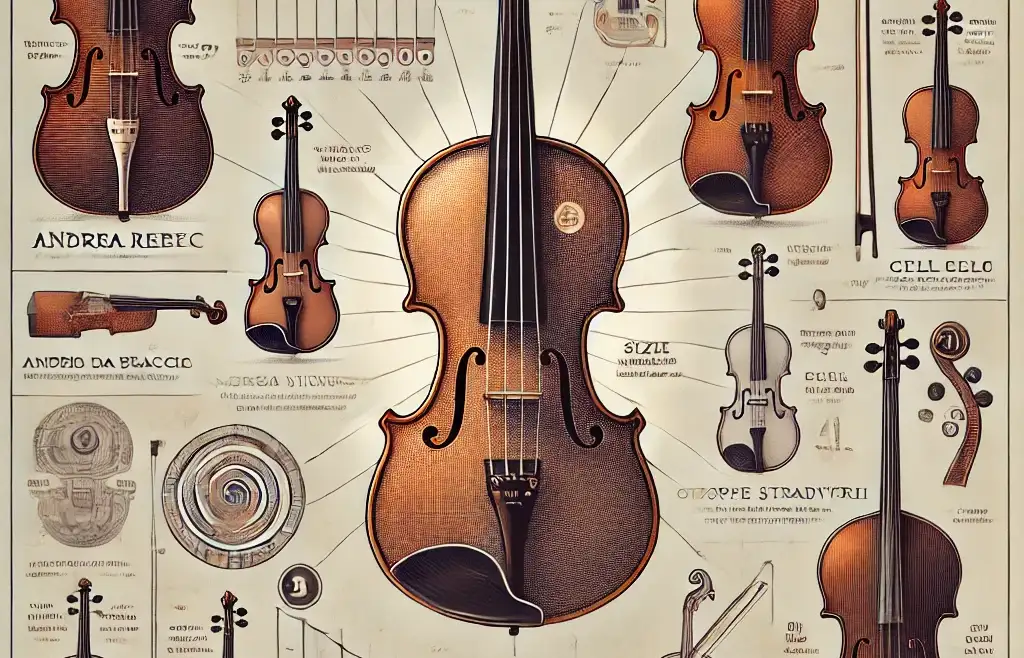
The violin’s origins trace back to the early bowed string instruments of the Middle Ages and the Renaissance. It evolved from instruments such as the rebec, an Arabic-influenced three-stringed instrument played with a bow, and the lira da braccio, a Renaissance-era bowed instrument from Italy.
The modern violin took shape in Northern Italy in the early 16th century, particularly in the regions of Brescia and Cremona. The first true violins appeared around 1550, crafted by luthiers such as Andrea Amati, the founder of the famous Amati family of violin makers.
The First Violin
The earliest known violin was created by Andrea Amati around 1555. Amati’s design included four strings tuned in perfect fifths (G-D-A-E), which set the standard for future violin construction. His violins were made for the court of King Charles IX of France, emphasizing their significance in European aristocratic and musical culture.
Amati’s work influenced later master luthiers, including Antonio Stradivari and Giuseppe Guarneri, who perfected the design and craftsmanship of the violin. Stradivari’s violins, crafted in the 17th and 18th centuries, remain some of the most sought-after instruments in the world today.
How a Violin is Made
Crafting a violin is a meticulous process that requires precision and artistry. Traditional violins are made from various types of wood, including:
- Spruce for the top plate (soundboard), which helps amplify the sound.
- Maple for the back, sides, and neck, providing strength and resonance.
- Ebony for the fingerboard, tuning pegs, and tailpiece, ensuring durability and smooth playability.
The body of the violin is constructed by carving and assembling these woods, while the varnish applied to the instrument enhances its sound and aesthetic appeal. The bridge, soundpost, and bass bar inside the violin help transmit vibrations and create the instrument’s distinctive tone.
The Evolution of the Violin Family
As the violin gained popularity, larger versions were developed to accommodate a wider range of musical needs. This led to the creation of the viola, cello, and double bass.
The Viola
The viola, slightly larger than the violin, was developed in the late 16th century. It has a deeper, richer sound due to its lower tuning (C-G-D-A) and is often used for harmony and accompaniment in string ensembles.
The Cello
The violoncello, or cello, emerged in the late 17th century as a larger instrument designed to play lower notes. Unlike the violin and viola, the cello is played while seated, with the instrument resting between the player’s knees. It is tuned one octave lower than the viola (C-G-D-A) and has become a staple in orchestras, chamber music, and even solo performances.
The Double Bass (Contrabass)
The double bass, also known as the contrabass or simply the bass, is the largest and lowest-pitched member of the violin family. It evolved from the viol family of instruments in the late 17th and early 18th centuries. Unlike other string instruments, the double bass is tuned in fourths (E-A-D-G) rather than fifths, allowing for greater playability in lower registers. It is an essential component of orchestras, jazz bands, and contemporary music genres.
The Violin in Modern Times
Over the centuries, the violin has remained a fundamental instrument in classical music while also expanding into various other genres, including jazz, folk, rock, and electronic music. Innovations in violin-making, such as electric violins, have further expanded its versatility.
Conclusion
The violin’s rich history and evolution demonstrate its significance in global music traditions. From its origins in Renaissance Italy to its presence in modern symphonies and contemporary music, the violin continues to captivate audiences with its beauty and expressiveness. Alongside the viola, cello, and double bass, it forms the backbone of the string family, ensuring its legacy for generations to come.